
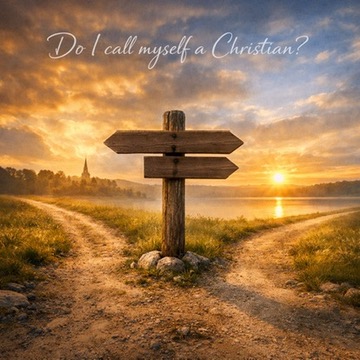
Do we choose our labels or do they choose us? For most of us it will be a mixture of both.
I wanted to re-run the series we have just finished for three reasons:
To hear from our two new members.
To fill a gap so we could all have a summer break.
To discover whether anything in the equation above had shifted.
My first attempt to answer the ‘am I still a Christian?’ question was written in one sitting and was published in my personal blog. The version I published here some months later was largely unchanged. It was as if Simon’s question opened a weak seam in my psyche and the magma spilled out. And I choose the volcano analogy deliberately because there is a good deal of pain, spiritual abuse and disappointment in my back story.
In the last twelve months I’ve been working with a therapist following a car accident, and have enrolled on a course with a view to becoming an existential therapist. Both have combined in intriguing ways.
This opportunity to work on myself whilst widening the categories available to me has brought some insight into how much of my early Christian journey was chosen for me. And by that I mean that the circumstances of my birth, my early upbringing and significant events that happened during my teenage years pretty much set me up to respond positively to a conservative evangelical spin on the story of Jesus, the events described in the gospels and the theology of Paul. When I use the words of Paul to describe my journey, I do so with no negative feelings:
“When I was a child, I talked like a child, I thought like a child, I reasoned like a child. When I became a man, I put the ways of childhood behind me.” *
Children can only think and react like… children. I am hugely grateful for my first encounter with Jesus and with many very kind Christians in my teenage years. But, as an adult, I now see the degree to which my early labels, and my preferred theology, chose me. And that which chose me went on to determine the churches I joined, the books I read and the theological institutions I applied to. And each of these played a role in helping me defend the choice that was made for me but led me to believe was my own.
Now, of course, I am describing an all too human tendency. So many systems of thought, and institutions that seek to perpetuate ideas that become dogma, have been built upon a felt need to outlast a visionary founder. Over time, followers turn a leader’s vision into roles, rules, routines and governance, and this process changes the very thing that inspired those followers into something more durable, scalable, and transferable.
So, a founder’s ideas, teachings and charisma get translated into formal processes, and authority shifts from one person to offices, committees, or systems. It is inevitable that leaders with a similar charisma, but who were formed by different forces, emerge; and all too often the character or ultimate goal of the originator is diluted or lost. Further growth and leadership succession force further adaptation beyond the founder’s personality, and the institution starts serving collective continuity, losing sight of the personal characteristics that combined to make the founder the magnetic leader others decided to follow. The institution is then only able to preserve a retrofitted understanding of the founder’s purpose, whilst still claiming to bear his name. There is also an observable tendency for followers of a dogma that has chosen them to be more stubbornly wedded to it than people who have made their own choice and know they are free to change their minds.
*
Once I discovered that the label that had chosen me was no longer one that described where my life is going I felt free to set it aside. And that freedom became a compulsion, probably because I’d left the decision too long. When bullies, racists, misogynists, egotists and charlatans see no incongruity in self-defining themselves as ‘Christians’, and wider society shrugs its shoulders I am out. To me, the label is irredeemable. If Jesus had included the label as part of the package of following him my decision would obviously have been different. But realising that Jesus was not the originator of Christianity was the truth that set me free.
*
I love the fact that each of us have answered the ‘am I still a Christian?’ question slightly differently, and that other members of the Collective have alluded to similar disappointments to mine and yet have reached a different conclusion. I hope this demonstrates that listening well to ourselves and thinking deeply with the help of others brings us the freedom to make our own distinct choices.
We need each other because the physicist Richard Feynman’s words to the US Congress are true: “the first principle is that you must not fool yourself, and you are the easiest person to fool”. For this reason, doubt is always better than unexamined certainty. Members of the Collective are seeking to listen carefully to ourselves and to each other because as we do so we are open to self-correction and revision. Thinking deeply necessitates listening and wrestling with other perspectives so we can test our conclusions and try out new ideas. The commitment to living authentically is rooted in the freedom we then have to choose which values will take the lead, and which ideas and theologies will guide us. All conclusions about God and ourselves in relation to God must always be provisional because, as Paul goes on to say in the very next verse:
“For now we see only a reflection as in a mirror; then we shall see face to face. Now I know in part; then I shall know fully, even as I am fully known.” *
* 1 Corinthians 13: 11 and 12.